

The Last Dance
A song can’t bring someone all the way back, but sometimes three minutes is enough.

If you grew up in the 1980s and went to a school dance, you knew exactly what it meant when “Stairway to Heaven” came on.
The night was over. Or almost over.
The DJ had one last trick. Parents were waiting outside. The gym lights were still low enough to make everyone look a little better than they did in English. And if you were lucky, you had eight minutes to hold someone close and pretend you weren’t counting every second.
That was “Stairway” for me.

Not classic rock history. Not a debate over whether Led Zeppelin was overrated, underrated, or exactly rated. Not a dissertation on Jimmy Page.
The last dance.
Am I right?
If you are flipping through stations, or scrolling Spotify for the younger readers, and “Stairway to Heaven” comes on, you stop. You may not even consider yourself a classic rock person anymore. Maybe you never were. Maybe hard rock is no longer your jam. Maybe you have moved on to podcasts, playlists, and songs that last two minutes and forty seconds because we’re too busy now for a proper guitar solo.
Doesn’t matter. You stop.
For eight minutes, you are listening to Led Zeppelin build that thing one note at a time. Page, Plant, Jones, and Bonham somehow stretch the song into something that still feels shorter than it should.
Maybe that’s why it still works.

There is something in it about wanting more. Something higher. Something just out of reach. We spend a lot of our lives trying to buy, earn, prove, or perform our way toward whatever version of “heaven” we think will finally settle us down.
And then, if we are lucky, we begin to realize the stairway was never for sale.
Maybe that’s too much meaning to put on a song that, for most of us, was really about hoping the person we liked would say yes when the slow dance started.
But music has a way of carrying more than we ask it to.
All of this to say: I don’t consider myself a music person.
I never really was growing up. Mostly, I remember being annoyed by how loud my older brother Bill played his music. In his room. In the car. Probably in places where music did not need to be played quite that loud. But it was classic rock, and even if I complained about the volume, I never really minded the music itself.
My own song choices were usually based on my mood at the time, which often meant they were tied to whichever girl I was hopelessly chasing and how much the song reminded me of her.
Music marks time better than almost anything else. Even those of us who are musically challenged, and I am placing myself firmly in that category, understand that certain songs become attached to certain rooms, certain people, certain versions of ourselves.
A song can put you back in a gymnasium, car, bedroom, hospital room, funeral, or sporting event.
If there is one thing I regret in how I cared for my dad during his Alzheimer’s journey, it is that I did not play more music for him. I think about that whenever Zeppelin or Queen start to play.
There are plenty of things you second-guess as a caregiver. Some are fair. Some are not. You do the best you can with the information, energy, patience, fear, and exhaustion you have at the time. Then later, when things are quieter, your brain starts pulling files from the cabinet.
Why didn’t I do more of that? Why didn’t I try this sooner? Why didn’t I know?
Music is one of those files for me.
Because music can reach a person with Alzheimer’s or dementia in a way ordinary conversation often can’t. Nothing we play is going to cure the disease. I wish it worked that way. Nothing reverses what Alzheimer’s takes.
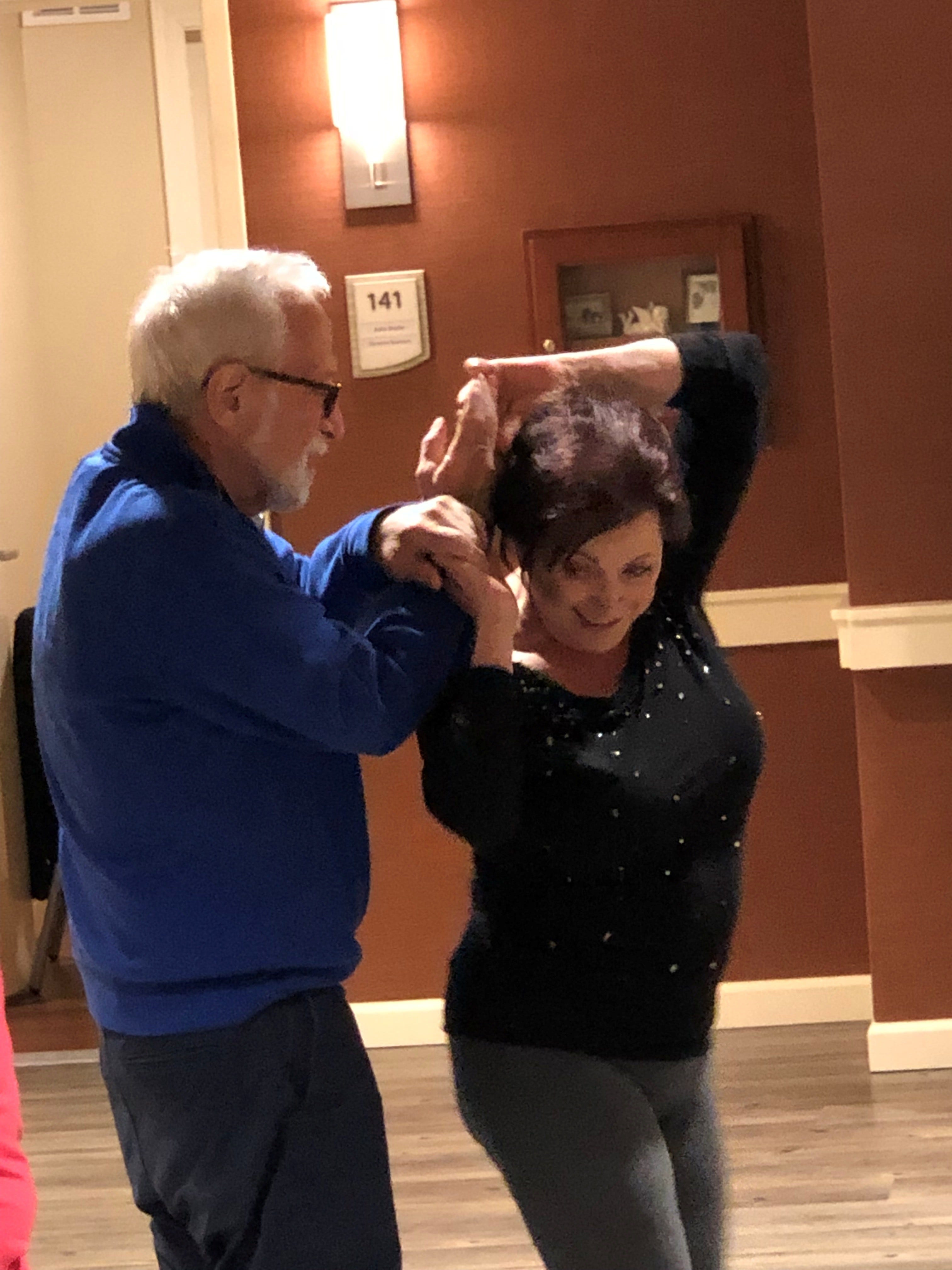
But music can create moments of recognition, calm, joy, movement, and connection. I’ll never forget visiting my dad one night and seeing him dancing with his friend, Mary. The way he moved with her. Smiling. Enjoying the moment.
I remember watching them and feeling that strange caregiver combination of joy and ache. Joy because he was happy. Ache because you want to bottle that version of the person and keep it safe somewhere the disease can never reach.
For a few minutes, the music gave him something back.
Or maybe it gave me something back.
That’s the part I wish I had understood sooner. Music wasn’t going to give me the old Dad back, but it might have given him more moments like that. More taps of the foot. More smiles. More movement. More chances for connection when conversation became difficult.
The Alzheimer’s Association says music may reduce agitation and behavioral issues, especially in the middle stages of the disease. Even in late-stage Alzheimer’s, a person may still tap a beat or sing lyrics from childhood.
Music can remain accessible even when language becomes harder. The Mayo Clinic has noted that parts of the brain connected to musical memory may be relatively less damaged by Alzheimer’s. That may be why familiar songs can still stir emotion, movement, and recognition when other kinds of memory are harder to reach.
For caregivers, this is important.
Not because it fixes the situation. It doesn’t. But because caregiving happens in places where everyone is trying so hard. Trying to explain or redirect. Trying to comfort or trying not to lose patience. Trying not to cry. Trying to remember that the disease is the problem, not the person.
Music can soften the room. It gives everyone something to do besides struggle.
And the best kind of music is their music. Not yours.
Sorry, Zeppelin.
Brown University researchers studying personalized music in dementia care focused on “early preferred music,” often from the teen years and early twenties, because those songs can trigger autobiographical memories and emotional responses. In one study, personalized music did not dramatically change every behavior measure, but it did provide momentary relief from verbal agitation.
Emphasis on the word “momentary.”
Sometimes families want music to bring the person all the way back. And sometimes, briefly, it almost feels like it does.
A frozen face melts or a hand reaches out. A person who has been quiet suddenly sings every word.
But even when the moment doesn’t last, it still counts. For the person with dementia, it can offer comfort. For the caregiver, it can feel like a glimpse of the person they love is still there.

Alzheimer’s steals so much, but music can sometimes slip through the locked doors—the vault, as I called it.
It may only return a smile or shared look of recognition. A few seconds where the fog lifts just enough for both of you to feel something familiar again.
But when it comes to memory-related diseases, a few seconds can make all the difference in both of your days.
The benefits of music are not reserved for people with dementia. They are just easier to see there.
A song does not fix grief. It does not erase stress, guilt, anxiety, pressure, sadness, or whatever else followed you into the room. It will not clean the house, pay the bills, answer the email, repair the relationship, or make the hard thing any less hard.
But it might give you three minutes back. Three minutes of breathing. Three minutes of remembering. Three minutes of not being completely owned by whatever was owning you a minute earlier.
And some days, that’s not a small thing.
Some days, that’s the whole dance.
See you next week.
Almost as strong as smells. I'm curious how smells affect the memory affected.
Great Article Mark!